
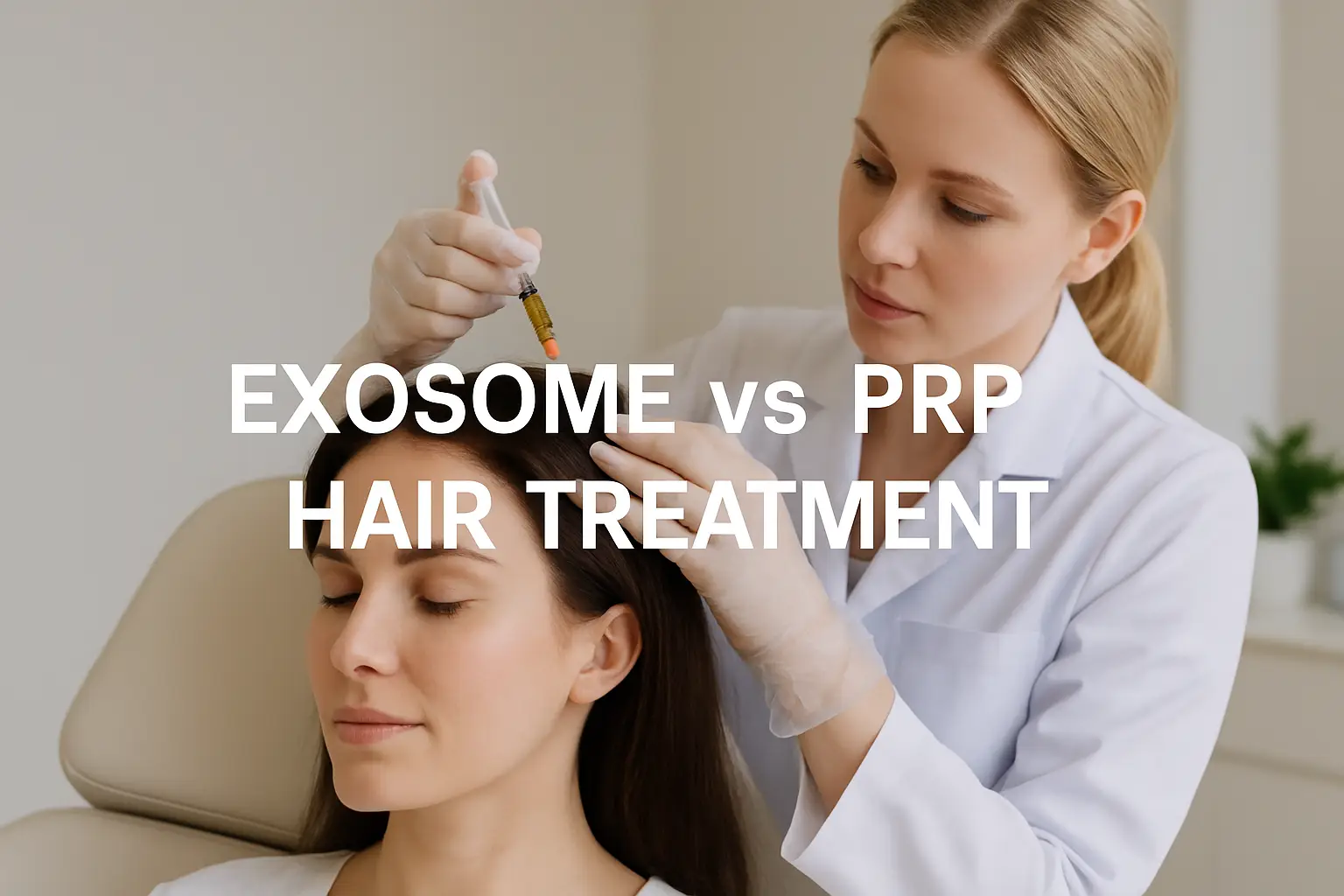
Hair loss is a common concern affecting millions of people worldwide, leading many to look for effective and reliable solutions. Among today’s most discussed regenerative options are Platelet-Rich Plasma (PRP) and exosome therapy. Both aim to support hair follicle regeneration and improve overall scalp health.
In this guide, we’ll take a clear and practical look at the differences between exosome and PRP hair treatments, including how they work, what results to expect, recovery time, costs, and how to decide which option may suit your needs.
Biological Mechanisms: How Exosome and PRP Stimulate Hair Growth
Although both treatments focus on stimulating the body’s natural repair processes, they work in different ways.
Platelet-Rich Plasma (PRP) Treatment
PRP therapy starts with drawing a small amount of the patient’s blood. This sample is processed using centrifugation to separate platelet-rich plasma. These platelets release growth factors such as platelet-derived growth factor (PDGF) and vascular endothelial growth factor (VEGF), which help repair tissue, reduce inflammation, and activate hair follicles in the growth phase.
Exosome Therapy
Exosome therapy is based on exosomes, which are tiny extracellular vesicles released by stem cells. These vesicles carry proteins, lipids, and genetic materials such as microRNAs. Unlike PRP, this treatment does not require a blood draw.
Instead, purified exosomes are applied to the scalp through targeted injections. These signaling particles help cells communicate more effectively, supporting hair follicle activation, reducing inflammation, and improving the overall scalp environment in a more targeted way.
Comparing Effectiveness: Which Treatment Delivers Better Results?
Effectiveness is one of the main factors when choosing between exosome and PRP treatments, and results can vary depending on the individual.
PRP has been used for years and is supported by many clinical studies showing improvements in hair density, thickness, and scalp condition. However, results can depend on factors such as platelet quality and consistency of treatment sessions.
Exosome therapy is a newer option, but it has gained attention for delivering noticeable results with fewer sessions. Because exosomes carry concentrated regenerative signals, they may help stimulate hair follicles more efficiently and improve scalp conditions faster. Early findings suggest that exosome-based treatments may offer more consistent outcomes, especially in moderate to advanced hair loss cases.
Recovery and Safety Profile: What to Expect
Both treatments are minimally invasive and generally well tolerated, with slight differences in recovery.
PRP Recovery
Since PRP involves both blood collection and injections, some patients may experience mild swelling, redness, or tenderness in the treated areas. These effects are temporary and usually resolve within a few days. There is typically no significant downtime.
Exosome Recovery
Exosome treatment is less invasive as it does not involve blood collection. Side effects are rare and usually limited to mild redness or slight scalp sensitivity. Most patients can return to their normal routine immediately after the procedure.
Cost and Accessibility: What You Should Consider
Cost is an important factor when comparing exosome vs PRP hair treatments, and it can vary depending on the clinic, location, and treatment plan.
PRP Costs: PRP is generally more affordable because it uses the patient’s own blood and standard medical equipment. It is widely available and typically requires multiple sessions.
Exosome Costs: Exosome therapy tends to be more expensive due to the advanced technology involved in producing and purifying exosomes. These treatments are usually offered in specialized clinics, which may limit availability in some regions.
Both options are considered elective procedures and are usually not covered by insurance.
Choosing the Right Treatment for You
The decision between exosome and PRP therapy depends on your specific situation and expectations.
- Type of Hair Loss: PRP is often suitable for early-stage hair thinning, while exosome therapy may be preferred in more advanced cases.
- Treatment Preference: If you prefer a more natural approach using your own blood, PRP may be ideal. If you want a more advanced regenerative option with fewer sessions, exosome treatment may be a better fit.
- Professional Evaluation: A detailed consultation with a qualified specialist is essential to determine the most appropriate approach for your scalp and hair condition.
Side-by-Side Comparison: Exosome vs PRP Hair Treatment
| Feature | PRP Treatment | Exosome Treatment |
|---|---|---|
| Source | Patient’s own blood | Stem cell-derived exosomes |
| Mechanism | Growth factors stimulate follicles | Cell signaling supports regeneration |
| Procedure | Blood draw + injections | Direct scalp injections |
| Sessions | 3–6 sessions | 1–3 sessions |
| Recovery | Mild downtime | Minimal to none |
| Cost | Moderate | Higher |
| Availability | Widely available | Specialized clinics |
Frequently Asked Questions
What is the main difference between exosome therapy and PRP?
PRP uses your own blood to deliver growth factors, while exosome therapy uses stem cell-derived exosomes to send regenerative signals directly to the scalp.
Which treatment works better for hair regrowth?
Both can be effective. PRP has more long-term data, while exosome treatments may deliver faster and more noticeable improvements in some cases.
Are there side effects?
Side effects are generally mild for both treatments. PRP may cause temporary swelling or redness, while exosome therapy usually has minimal reactions.
How many sessions are needed?
PRP usually requires multiple sessions, while exosome treatment may show results with fewer applications.
Can these treatments be combined?
Yes, some treatment plans combine PRP and exosomes to enhance overall results.
Who is a good candidate?
Individuals with early to moderate hair loss may benefit from both treatments. Advanced cases may respond better to exosome-based approaches.
References
- Gentile P et al. Stem Cells Transl Med. 2015.
- Yu B et al. Stem Cell Res Ther. 2019.