
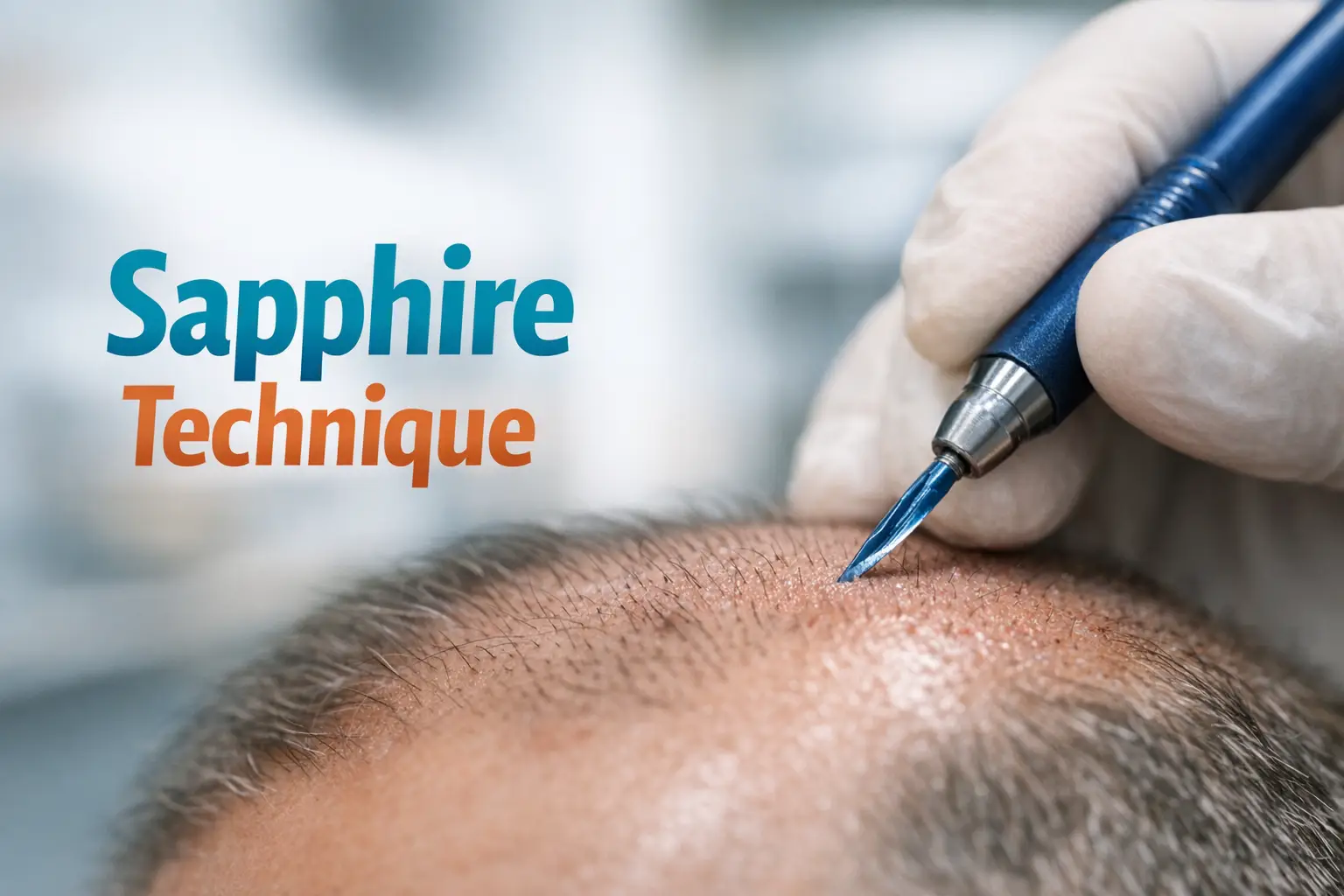
Sapphire Hair Transplant in Turkey
Sapphire hair transplant is a variation of the FUE technique in which sapphire-tipped blades are used to create recipient channels before graft implantation. The aim is to support precise channel planning, natural graft direction, and careful density distribution in suitable patients.
In Turkey, Sapphire hair transplant is often considered by international patients who want a modern FUE-based approach with detailed recipient area planning. However, the success of the procedure depends not only on the blade material, but also on donor area evaluation, graft handling, hairline design, and realistic density expectations.
At Quartz Hair Clinic in Istanbul, our medical team evaluates each patient’s donor area, hair loss pattern, scalp condition, and long-term goals before recommending Sapphire FUE, standard FUE, DHI, or a staged treatment plan.
What Is Sapphire Hair Transplant?
Sapphire hair transplant is not a completely separate hair transplant method. It is commonly described as a refined form of FUE hair transplant, where the main difference is the use of sapphire-tipped blades during recipient channel creation.
During FUE, grafts are extracted individually from the donor area. In Sapphire FUE, the extracted grafts are implanted into channels opened with sapphire blades. These channels must be planned carefully according to angle, direction, depth, and spacing.
The sapphire blade itself does not guarantee a better result. Natural outcomes depend on the full medical plan, including donor safety, graft quality, hairline design, and post-operative care.
How Does Sapphire FUE Work?
The Sapphire FUE process follows the same general principles as FUE hair transplantation. The main difference appears during the channel-opening stage.
- Consultation: The donor area, recipient area, hair loss pattern, and expectations are evaluated.
- Donor planning: Safe graft extraction capacity is assessed before deciding the treatment plan.
- Local anesthesia: The procedure is performed under local anesthesia to support patient comfort.
- Graft extraction: Follicular units are removed individually from the donor area.
- Sapphire channel creation: Recipient channels are opened using sapphire-tipped blades.
- Graft implantation: Extracted grafts are placed into the prepared channels.
- Aftercare: The patient receives washing, medication, and follow-up instructions.
Each step affects the final result. Even with advanced instruments, poor donor planning or incorrect graft direction may lead to an unnatural appearance.
Sapphire FUE vs FUE Hair Transplant
Sapphire FUE and standard FUE are closely related. Both techniques use individual follicular unit extraction. The main difference is the blade used to create recipient channels.
| Feature | Standard FUE | Sapphire FUE |
|---|---|---|
| Extraction Method | Individual follicular unit extraction | Individual follicular unit extraction |
| Channel Creation | Usually performed with standard surgical blades | Performed with sapphire-tipped blades |
| Planning Focus | Natural graft angle, spacing, and coverage | Precise channel planning in suitable cases |
| Suitability | Suitable for many standard FUE cases | May be considered depending on scalp and graft needs |
Sapphire FUE vs DHI Hair Transplant
Sapphire FUE and DHI differ mainly in the implantation stage. In Sapphire FUE, channels are created first with sapphire-tipped blades, and grafts are then placed into those channels. In DHI hair transplant, grafts are implanted directly using an implanter pen.
DHI may be preferred for selected hairline, temple, or density refinement cases where controlled placement is important. Sapphire FUE may be more suitable for patients who need broader channel planning over a larger recipient area.
Patients comparing methods can also read our detailed guide on DHI vs FUE hair transplant.
Advantages and Limitations of Sapphire Hair Transplant
Sapphire FUE may offer practical advantages in selected patients, but it should not be presented as automatically superior for every case. The technique must be matched to the patient’s donor area, recipient area, and long-term hair loss pattern.
Potential Advantages
When planned properly, Sapphire FUE may support precise recipient channel creation and natural graft direction.
- May support controlled channel planning
- Can be used for natural hairline and density planning
- May help with refined graft placement in selected cases
- Can be suitable for broader FUE-based procedures
- Does not require a linear donor incision
Possible Limitations
Sapphire blades do not replace medical planning. Poor donor management, unrealistic density goals, or incorrect graft placement may still lead to unsatisfactory results.
- Not automatically suitable for every patient
- Still requires careful donor extraction planning
- May not be ideal if donor reserves are weak
- Results depend on graft survival and aftercare
- Cannot guarantee higher density by itself
Who Is a Suitable Candidate for Sapphire FUE?
Sapphire FUE may be suitable for patients who have adequate donor hair and need careful recipient area planning. Suitability should always be confirmed after medical evaluation.
- Patients with mild to advanced hair loss depending on donor capacity
- Patients needing frontal, mid-scalp, or crown coverage
- Individuals with suitable donor density
- Patients who want an FUE-based technique
- Patients with realistic density expectations
- Individuals who can follow post-operative care instructions
Who May Not Be Suitable?
Some patients may need a different technique, staged planning, or medical treatment before surgery.
- Patients with very weak donor areas
- Individuals with diffuse thinning in the donor zone
- Patients with active scalp inflammation or untreated skin disease
- People expecting maximum density from one session
- Patients with medical conditions that may affect healing
- Individuals with rapidly progressing hair loss
Sapphire Hair Transplant Cost in Turkey
Sapphire hair transplant cost in Turkey depends on the patient’s individual needs. Important factors include graft count, donor area condition, recipient area size, technique planning, clinic infrastructure, and follow-up care.
Compared with many clinics in Europe and the United States, Turkey generally offers more accessible treatment costs. These differences are usually related to healthcare infrastructure, operational expenses, regional economic factors, and the organization of medical tourism services.
The final cost should always be confirmed after consultation. Patients should avoid choosing a clinic based only on the advertised technique or price. Donor safety, natural planning, hygiene standards, and follow-up care are equally important.
| Cost Factor | Why It Matters |
|---|---|
| Graft Count | Larger sessions require more extraction, planning, and procedure time |
| Technique Selection | Sapphire FUE, FUE, or DHI may differ in planning and execution |
| Donor Area Condition | Weak donor areas may require conservative or staged planning |
| Recipient Area Size | Large areas may need careful density distribution |
| Aftercare and Follow-Up | Post-operative support helps guide recovery and healing |
Can Sapphire FUE Be Used for Large Graft Sessions?
Sapphire FUE may be considered for larger graft sessions in suitable patients, but donor safety must remain the first priority. High graft numbers should not be planned unless the donor area can support safe extraction.
Patients researching larger procedures can review our guide on 5000 grafts hair transplant cost in Turkey to understand how graft number, donor capacity, and cost factors are evaluated.
How Proper Planning Helps Prevent Poor Results
Even with Sapphire FUE, poor planning may lead to visible donor thinning, low density, unnatural hairline design, or weak graft survival. The technique is only one part of the result.
Patients should understand how the donor area will be protected, how density will be distributed, and whether the planned hairline will look natural over time. Our guide on hair transplant gone wrong explains the warning signs and causes of poor outcomes.
Good preparation also matters before surgery. Patients can review our guide on before hair transplantation for practical pre-procedure considerations.
Sapphire Hair Transplant Recovery Timeline
Recovery after Sapphire FUE is similar to standard FUE. Mild redness, swelling, small scabs, donor area sensitivity, and temporary shedding may occur during the early healing period.
| Time Period | What Patients May Expect |
|---|---|
| First Few Days | Mild swelling, redness, and scalp sensitivity may occur |
| Days 7–14 | Scabs usually begin to clear with proper washing guidance |
| Weeks 2–6 | Temporary shedding may occur as part of the normal growth cycle |
| Months 3–6 | Early new growth may become visible |
| Months 12–18 | Final density, texture, and growth pattern continue to mature |
Patients should follow post-operative instructions carefully and avoid judging the final result too early. Hair growth develops gradually over several months.
Clinical Experience
In our clinical experience, patients often ask whether Sapphire FUE is better than standard FUE. The more important question is whether the scalp, donor area, and graft plan are suitable for this approach. When the indication is correct, careful channel planning can support a natural-looking result.
Medical Review
This article has been medically reviewed for accuracy, balance, and alignment with current hair restoration principles. Information about Sapphire FUE, technique comparison, cost, recovery, and suitability is presented to support realistic patient expectations and medically responsible decision-making.
Frequently Asked Questions
What is Sapphire hair transplant?
Sapphire hair transplant is a variation of FUE where sapphire-tipped blades are used to create recipient channels before graft implantation. Grafts are still extracted individually from the donor area.
Is Sapphire FUE better than regular FUE?
Sapphire FUE is not automatically better for every patient. It may support precise channel planning in suitable cases, but the result depends on donor evaluation, graft handling, and surgical planning.
Is Sapphire FUE the same as DHI?
No. Sapphire FUE uses sapphire-tipped blades for channel creation, while DHI uses an implanter pen for direct graft placement. The best option depends on the patient’s needs.
How much does Sapphire hair transplant cost in Turkey?
The cost depends on graft count, donor area condition, clinic infrastructure, technique planning, and aftercare needs. Final pricing should be confirmed after individual medical evaluation.
Does Sapphire hair transplant heal faster?
Some patients may experience a smooth healing process, but recovery depends on many factors including technique, scalp condition, graft count, and aftercare. It should not be presented as guaranteed faster healing.
Can Sapphire FUE be used for 5000 grafts?
It may be considered in suitable patients, but donor safety must be evaluated carefully. Very large sessions require realistic graft planning and donor protection.
Does Sapphire FUE leave scars?
Sapphire FUE does not create a linear scar, but small dot-like extraction marks may occur in the donor area. Careful donor planning helps keep donor changes discreet.
Additional FAQs
Is Sapphire hair transplant painful?
The procedure is performed under local anesthesia, so pain is usually controlled during surgery. Mild soreness or sensitivity may occur during early recovery.
Who is suitable for Sapphire FUE?
Suitable candidates usually have adequate donor hair, stable scalp health, and realistic expectations. A medical evaluation is needed to confirm suitability.
Can women have Sapphire FUE?
Some women may be suitable, depending on their hair loss pattern and donor stability. Female hair loss should be carefully evaluated before surgery.
Scientific References
View Scientific References
Follicular Unit Extraction: Minimally Invasive Surgery for Hair Transplantation
Rassman WR, Bernstein RM, McClellan R, Jones R, Worton E, Uyttendaele H. Dermatologic Surgery. 2002;28(8):720-728. PMID: 12174065. DOI: 10.1046/j.1524-4725.2002.01320.x.
Follicular Unit Transplantation: 2005
Bernstein RM, Rassman WR. Dermatologic Clinics. 2005;23(3):393-414. PMID: 16039422. DOI: 10.1016/j.det.2005.04.002.
Hair Transplantation: Basic Overview
Jimenez F, Alam M, Vogel JE, Avram M. Journal of the American Academy of Dermatology. 2021;85(4):803-814. PMID: 33905785. DOI: 10.1016/j.jaad.2021.03.124.
A Scoping Review on Complications in Modern Hair Transplantation
Liu RH, Xu LJ, McCarty JC, Xiao R, Chen JX, Lee LN. Aesthetic Plastic Surgery. 2025;49:585-595. PMID: 39179656. DOI: 10.1007/s00266-024-04316-3.