
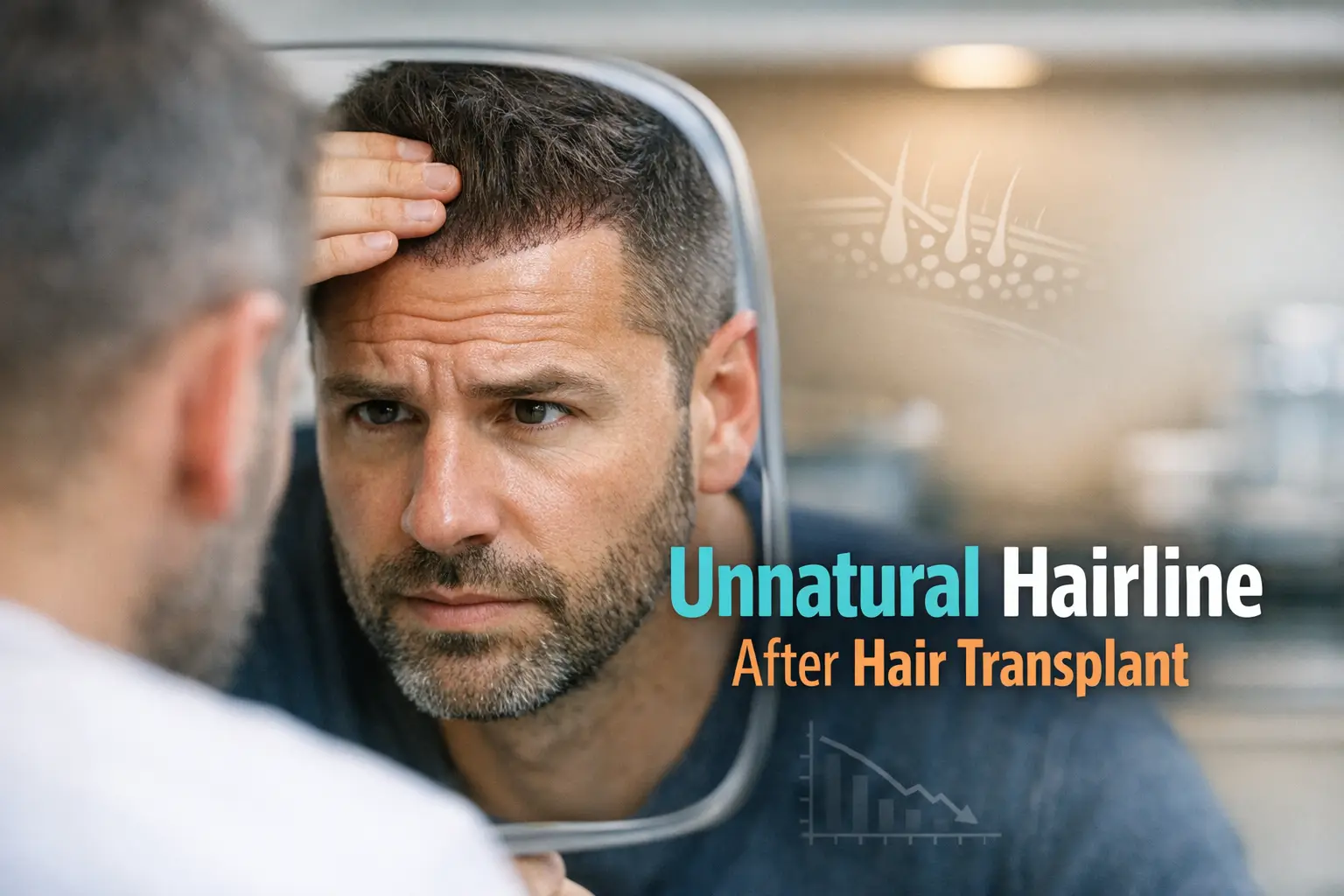
A natural hairline is not perfectly straight or evenly dense. It usually has soft irregularities, fine single-hair grafts at the front, and gradual density behind the leading edge. When these details are missed, patients may notice a pluggy look, harsh shape, low hairline, or hairs growing in the wrong direction.
An unnatural hairline is one of the most common cosmetic concerns seen after a hair transplant gone wrong, especially when the result grows but does not look natural.
Why Can a Hair Transplant Create an Unnatural Hairline?
Hair transplant results depend on medical planning, surgical technique, donor hair characteristics, and realistic expectations. A transplant can grow successfully but still look unnatural if the hairline is designed too aggressively or if grafts are placed without proper angulation.
In many cases, patients do not notice the full issue immediately. Early redness, swelling, shedding, and uneven growth can temporarily affect the appearance. A true assessment is usually more accurate after the transplanted hair has matured.
If the concern is not limited to the hairline and includes patchy growth, visible scarring, or poor graft direction, patients may also review the broader signs of a bad hair transplant.
Natural Hairlines Are Not Perfectly Straight
One of the most common mistakes is designing a hairline that looks too sharp, too low, or too symmetrical. Natural hairlines usually have small variations in shape and density. These subtle irregularities make the result look softer and more realistic.
A hairline that looks like a drawn line across the forehead can appear artificial even if the grafts grow well.
Common Causes of an Unnatural Hairline After Hair Transplant
Several factors can contribute to an unnatural result. Sometimes one issue is responsible, but in many revision cases, several small problems are present together.
Poor Hair Direction and Angulation
Natural frontal hairs grow at specific angles and usually lie close to the scalp. If grafts are placed too upright or in the wrong direction, the hair may stick out or grow against the natural flow.
Pluggy or Doll-Like Appearance
The front of the hairline should usually be built with fine single-hair grafts. When larger multi-hair grafts are placed at the very front, the result may look pluggy, heavy, or unnatural.
Hairline Placed Too Low
A very low hairline can look unnatural as the patient ages. It may also use too many grafts too early, leaving fewer donor reserves for future hair loss.
When too many grafts are used without long-term planning, the donor area may also be affected. You can read more about overharvested donor areas after hair transplant.
Excessive Density at the Front
More density does not always mean a better result. Natural hairlines usually have a softer leading edge, with density increasing gradually behind it.
If the density behind the hairline remains weak or patchy, the concern may be related to low density hair transplant results.
- Incorrect graft angle can make hairs grow upward.
- Large grafts at the front can create a pluggy appearance.
- A straight hairline can look artificial.
- A very low hairline may not age naturally.
- Poor blending can make transplanted and native hair look disconnected.
| Hairline Problem | Common Cause | Possible Correction |
|---|---|---|
| Hair growing upward | Incorrect graft angulation | Hairline revision or camouflage grafting |
| Pluggy appearance | Multi-hair grafts placed at the front | Single-hair graft refinement |
| Hairline too low | Aggressive design planning | Selective graft removal or redesign |
| Visible gaps | Low density, poor growth, or shock loss | Additional grafting or supportive treatment |
| Harsh straight line | Overly uniform hairline design | Softening with irregular single-hair grafts |
Can an Unnatural Hairline Improve Over Time?
Sometimes, yes. In the early months after a hair transplant, the hairline may look uneven because the transplanted hairs are growing at different speeds. Redness, temporary shedding, and changes in surrounding native hair can also affect the appearance.
Most transplanted hair needs 12 to 18 months to mature fully. For this reason, it is usually too early to judge the final result in the first few months. However, if the hairline remains too low, too straight, pluggy, or poorly angled after maturation, corrective treatment may be needed.
Effective Solutions for Correcting an Unnatural Hairline
The right correction depends on the cause of the problem. Some cases can be improved with minor refinement, while others require a more detailed revision plan.
When the problem involves more than the frontal hairline, a broader corrective strategy may be necessary. You can review our detailed guide on hair transplant repair options.
Hairline Revision Surgery
Hairline revision may involve adding fine single-hair grafts to soften the front edge, changing the visual shape of the hairline, or improving density in selected areas. This requires careful planning because the scalp may already contain scar tissue from the first procedure.
Selective Graft Removal
If the hairline was placed too low or contains large grafts in the wrong position, selected grafts may need to be removed. This is usually a delicate process and may require more than one session.
Camouflage Grafting
In some cases, the existing hairline can be improved by placing finer grafts in front of or around the problematic area. This can soften a pluggy look and help the transplanted hair blend more naturally.
Scalp Micropigmentation and Supportive Treatments
Scalp micropigmentation may help reduce the contrast between hair and scalp, especially in patients with thin coverage. PRP or other supportive treatments may improve scalp health and hair quality, but they cannot correct poor graft direction or an incorrectly designed hairline by themselves.
Who Is a Suitable Candidate for Hairline Revision?
Hairline revision may be suitable for patients whose transplant has matured but still looks unnatural due to design, density, or graft placement issues. A detailed examination is needed to understand whether the problem can be improved safely.
- Patients with a pluggy or harsh frontal hairline
- Patients with grafts growing in the wrong direction
- Individuals with a hairline placed too low
- Patients with enough donor hair for refinement
- Individuals with realistic expectations about improvement
Who May Not Need Hairline Correction?
Not every early concern requires revision. Some patients simply need more time for the transplanted hair to grow, thicken, and settle into a more natural appearance.
- Patients within the first few months after surgery
- Patients experiencing temporary shock loss
- Individuals with mild uneven growth during early maturation
- Patients whose concern is mainly related to styling or lighting
- Patients without enough donor hair for safe correction
Costs and Risks of Hairline Revision
The cost of correcting an unnatural hairline depends on the complexity of the case, graft removal needs, revision technique, donor availability, and whether supportive treatments are included.
Hair transplant and revision costs in Turkey are generally lower than in many European countries and the United States. These differences are usually related to healthcare infrastructure, operational expenses, and regional cost factors. The final cost must still be determined individually after evaluating the hairline, donor area, and treatment goals.
Hairline revision may carry risks such as scarring, shock loss, reduced donor availability, and the need for more than one procedure. For this reason, revision planning should be conservative and realistic.
Clinical Experience
In our clinical experience, the most difficult unnatural hairlines are often not caused by low density alone, but by poor design decisions made at the frontal edge. A slightly higher, softer hairline with correct graft direction usually ages better than a very low and dense hairline that looks artificial.
Medical Review
This article has been medically reviewed for accuracy and balance in line with current hair transplantation and revision principles. Hairline correction should always be planned after individual assessment of graft direction, donor reserves, scalp condition, and long-term hair loss risk.
Frequently Asked Questions
Why does my hairline look unnatural after a hair transplant?
An unnatural hairline may be caused by poor graft direction, a hairline that is too straight or too low, excessive density, or large grafts placed at the front. Early swelling and uneven growth can also temporarily affect appearance.
Can an unnatural hairline be corrected?
Yes, many unnatural hairlines can be improved with revision surgery, camouflage grafting, or selective graft removal. The best option depends on the cause and severity of the problem.
How long should I wait before hairline revision?
In most cases, patients should wait at least 12 months before deciding on revision. This allows the transplanted hair to mature and gives a clearer view of the final result.
Can PRP fix a bad hairline?
PRP may support hair quality and scalp healing, but it cannot correct poor hairline design or wrong graft direction. It is usually considered a supportive treatment rather than a revision method.
Is a low hairline always unnatural?
Not always, but a hairline that is too low for the patient’s age, face shape, or future hair loss pattern may look artificial. A natural hairline should be designed with long-term planning in mind.
Does scalp micropigmentation help with an unnatural hairline?
Scalp micropigmentation may help reduce visible contrast and improve the appearance of thin areas. However, it does not change hair direction or remove poorly placed grafts.
Additional FAQs
Can large grafts at the hairline be removed?
In selected cases, large or misplaced grafts can be removed or redistributed. This should be done carefully to reduce the risk of visible scarring.
Can a pluggy hairline be softened?
Yes, a pluggy hairline can often be softened by placing fine single-hair grafts around the frontal edge. This helps create a more gradual and natural transition.
Will hairline revision require another full transplant?
Not always. Some patients need only a limited refinement procedure, while others may need a more detailed revision plan depending on the original result.
Scientific References
View Scientific References
Hair Transplantation: Techniques and Outcomes
Shapiro R, et al. Hair transplantation: techniques and outcomes. Journal of the American Academy of Dermatology. 2011;65(4):804-815. DOI: 10.1016/j.jaad.2010.08.008.
Hair Transplantation: The State of the Art
Rassman WR, et al. Hair transplantation: the state of the art. Dermatologic Surgery. 2002;28(8):720-729. PMID: 12175138.
Follicular Unit Transplantation
Bernstein RM, Rassman WR. Follicular unit transplantation: 2005. Dermatologic Surgery. 2005;31(4):423-431. DOI: 10.1111/j.1524-4725.2005.31116.x.
Hair Transplantation: Techniques and Applications
Jimenez F, Ruifernandez JM. Hair transplantation: techniques and applications. Clinics in Dermatology. 2007;25(6):591-601. DOI: 10.1016/j.clindermatol.2007.06.003.