
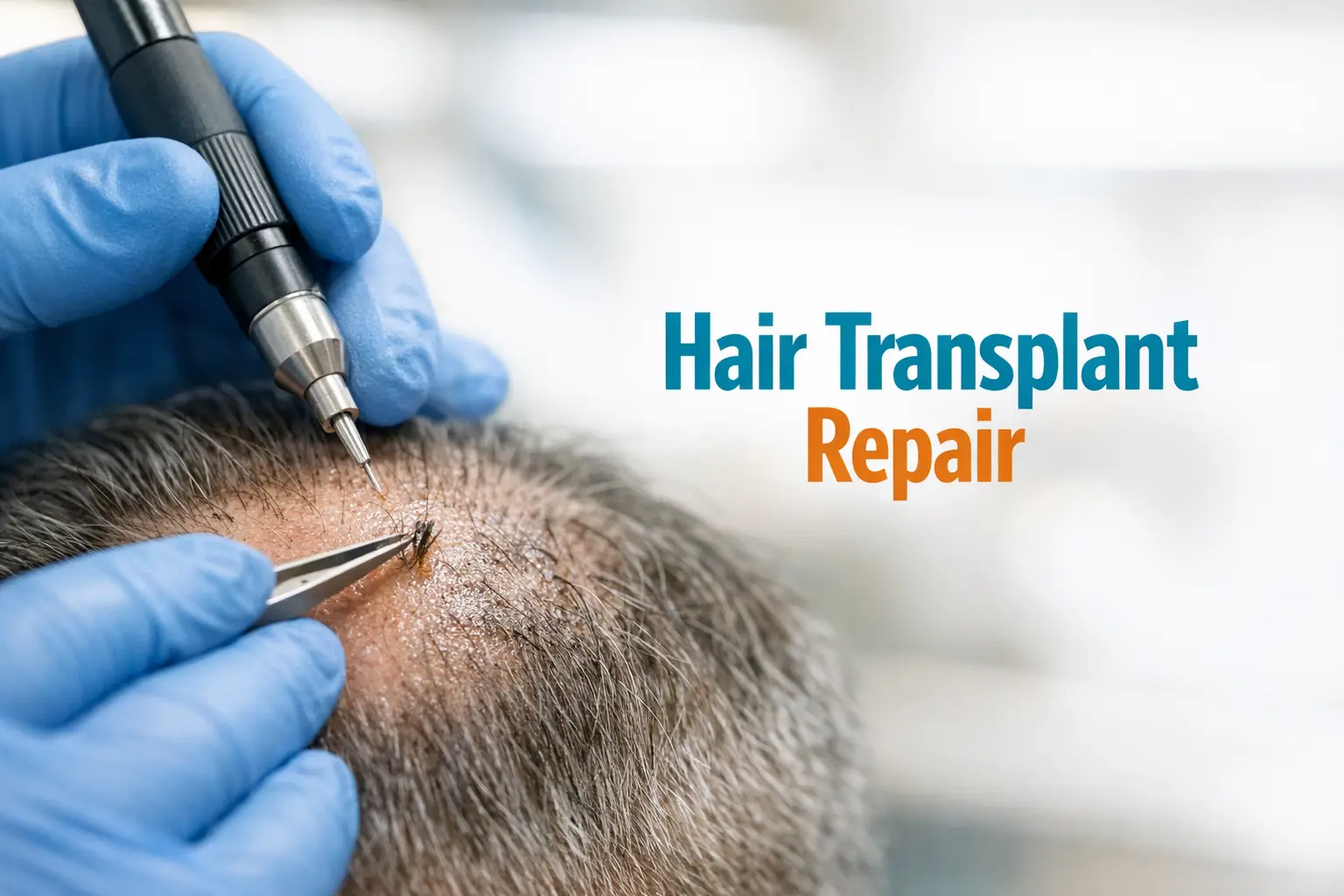
Most hair transplant repair procedures focus on refining existing work rather than reversing the entire transplant. The best approach depends on donor availability, scalp condition, previous surgical technique, and the patient’s long-term hair restoration goals. Repair may be considered after a hair transplant gone wrong, especially when the result affects both appearance and confidence.
What Is Hair Transplant Repair?
Hair transplant repair refers to corrective treatments performed after a previous hair restoration procedure. The aim is to improve cosmetic balance, soften unnatural results, increase density where possible, and reduce visible signs of older or poorly planned techniques.
In many cases, repair does not mean removing every transplanted graft. A more conservative plan may involve adding carefully placed grafts, correcting the hairline, improving coverage, or camouflaging donor area scars.
Common Reasons Patients Seek Hair Transplant Repair
Patients may consider corrective treatment for different reasons. Some issues are related to older transplant methods, while others may come from poor planning, low graft survival, or continued hair loss after the first procedure.
- Unnatural or overly straight hairline
- Visible plugs or clumped grafts
- Low density or patchy growth
- Incorrect hair direction or angulation
- Visible donor area scarring
- Overharvested donor area
- Progressive hair loss around transplanted hair
Signs That Corrective Hair Transplant Surgery May Be Needed
Not every disappointing result requires surgery. In the first months after a hair transplant, temporary shedding, uneven growth, and redness can make the result look worse than it will be later. A more accurate evaluation is usually possible after the transplanted hair has matured.
Patients who are unsure whether their result is healing normally or developing into a poor outcome can review the broader signs of a bad hair transplant.
Unnatural Hairline Shape
A hairline that is too low, too straight, or too dense at the front can look artificial. A natural hairline usually contains small irregularities, fine single-hair grafts, and a gradual increase in density behind the leading edge.
Hairline repair is often needed when the frontal design does not match the patient’s age, facial proportions, or natural growth pattern. Learn more about unnatural hairlines after hair transplant.
Visible Plugs or Clumping
Older transplant techniques sometimes used larger grafts that can create a plug-like appearance. These grafts may be especially noticeable at the frontal hairline or under strong lighting.
Poor Density or Patchiness
Patchy growth may occur when graft survival is low, the original graft distribution was uneven, or the treated area was too large for the number of grafts used. Additional grafting may help improve coverage if the donor area allows it.
When the main concern is sparse coverage rather than hairline shape, the case may be related to low density hair transplant results.
Donor Area Scarring
Visible scars, overharvesting, or thinning in the donor area may affect the overall appearance of the result. In some cases, scar revision, scalp micropigmentation, or careful graft placement may be considered.
If the donor area looks visibly thin, patchy, or depleted after surgery, this may indicate an overharvested donor area.
| Hair Transplant Issue | Common Cause | Potential Solution |
|---|---|---|
| Unnatural Hairline | Poor design or graft placement | Hairline revision |
| Visible Plugs | Older or large graft techniques | Single-hair graft refinement |
| Patchy Density | Low graft survival or uneven placement | Additional grafting |
| Donor Scarring | Previous surgery or overharvesting | Scar revision or SMP |
| Poor Hair Direction | Incorrect graft angulation | Corrective graft placement |
Hair Transplant Repair Techniques
The most suitable repair technique depends on the type and severity of the problem. In many cases, more than one method may be combined to achieve a softer and more natural appearance.
Follicular Unit Extraction (FUE)
FUE is commonly used in repair cases because individual grafts can be harvested and placed with precision. It may be used to improve density, soften a harsh hairline, or camouflage previous graft placement.
Hairline Revision
Hairline revision focuses on improving the shape, position, and softness of the frontal hairline. Fine single-hair grafts are often used to create a more natural transition at the front.
Graft Redistribution
In selected cases, poorly positioned grafts may be removed or redistributed. This requires careful planning because previously transplanted areas may contain scar tissue or reduced scalp flexibility.
Scalp Micropigmentation
Scalp micropigmentation can help reduce visible contrast between the scalp and hair. It may be useful for camouflaging scars or creating the appearance of greater density, especially when donor hair is limited.
Supportive Treatments
PRP, exosome therapy, or other supportive treatments may help improve scalp health and hair quality. These treatments cannot correct poor graft placement by themselves, but they may support a broader repair plan.
Who Is a Suitable Candidate for Hair Transplant Repair?
Hair transplant repair may be suitable for patients who are dissatisfied with a previous transplant and have realistic expectations about improvement. A detailed assessment is needed to determine whether the issue can be corrected safely.
- Patients with unnatural or pluggy hairlines
- Individuals with visible gaps or poor density
- Patients with grafts growing in the wrong direction
- People with donor area scarring
- Patients with enough donor hair for refinement
Who May Not Be a Suitable Candidate?
Some patients may not need immediate repair surgery. Others may not be suitable because of limited donor reserves, unstable hair loss, or scalp conditions that need treatment first.
- Patients within the first 12 months after a hair transplant
- Individuals experiencing temporary shock loss
- Patients with unrealistic expectations
- People with severely depleted donor hair
- Individuals with untreated scalp inflammation or skin disease
Recovery After Hair Transplant Repair
Recovery depends on the repair technique used and the size of the treated area. Most patients experience mild redness, swelling, and small scabs during the early healing period.
- Days 1–10: Initial healing, redness, and scabbing
- Weeks 2–4: Temporary shedding may occur
- Months 3–4: Early regrowth may begin
- Months 6–9: Visible improvement becomes clearer
- Months 12–18: Final maturation of results
Because repair cases may involve previously operated scalp tissue, follow-up care is especially important. Patients should avoid rushing the process and allow enough time for the result to mature.
What Factors Influence Hair Transplant Repair Cost?
The cost of hair transplant repair depends on the complexity of the case, the number of grafts required, donor area condition, technique selection, and whether supportive treatments are included.
Hair transplant repair costs in Turkey are generally lower than in many European countries and the United States. These differences are usually related to healthcare infrastructure, operational expenses, and regional economic factors. The final cost still depends on individual needs such as graft count, correction type, and treatment planning.
Important cost factors include:
- Extent of correction required
- Number of grafts needed
- FUE or other repair technique selection
- Donor area condition
- Need for scar camouflage or SMP
- Number of planned sessions
Clinical Experience
In our clinical experience, many repair patients do not need a full reconstruction. Targeted refinement of the hairline, improved graft distribution, and careful donor planning can often create a meaningful cosmetic improvement while preserving future treatment options.
Medical Review
This article has been medically reviewed for accuracy and reflects current principles used in modern hair transplant repair procedures. Treatment recommendations should always be based on an individual assessment of donor availability, scalp condition, graft placement, and long-term hair restoration goals.
Frequently Asked Questions
Can a bad hair transplant be fixed?
Many poor hair transplant results can be improved with corrective procedures. The available options depend on donor hair reserves, scalp condition, and the type of problem being corrected.
How long should I wait before considering hair transplant repair?
Most patients should wait at least 12 months after the original procedure. This allows the transplanted hair to mature and gives a more accurate view of the final result.
Is FUE commonly used for repair procedures?
Yes, FUE is commonly used because it allows precise graft placement and usually creates minimal additional scarring. It can be useful for improving density and softening unnatural areas.
Can scalp micropigmentation replace repair surgery?
Scalp micropigmentation can camouflage scars and reduce scalp contrast, but it cannot correct poor hair direction or an unnatural hairline by itself. It is often used as a supportive option.
Will I need more than one repair session?
Some patients achieve improvement with one session, while others may need staged treatment. This depends on the severity of the issue and the amount of donor hair available.
Can repair surgery stop future hair loss?
No, repair surgery improves the appearance of previous transplant work but does not stop genetic hair loss. Additional medical or supportive treatments may be recommended when appropriate.
Additional FAQs
Is hair transplant repair more difficult than the original procedure?
In many cases, yes. Repair surgery often requires working around scar tissue, older grafts, and limited donor reserves.
Can donor scars be improved?
Some donor scars can be improved with scar revision, scalp micropigmentation, or carefully placed grafts. The best option depends on scar type and donor area condition.
Are hair transplant repair results permanent?
Transplanted grafts are generally long-lasting, but surrounding native hair may continue to thin over time. Long-term planning is important for maintaining a balanced result.
Scientific References
View Scientific References
Revision of Hair Transplant Surgery: Indications and Techniques
Jimenez F, et al. Journal of Clinical and Aesthetic Dermatology. 2017. PMCID: PMC5579646.
Follicular Unit Transplantation
Bernstein RM, Rassman WR. Dermatologic Surgery. PMID: 15937881.
Follicular Unit Extraction: Minimally Invasive Surgery for Hair Transplantation
Rassman WR, et al. Dermatologic Surgery. DOI: 10.1046/j.1524-4725.2002.01144.x.
Hair Restoration: Surgical and Medical Options
Shapiro R, et al. Journal of the American Academy of Dermatology. DOI: 10.1016/j.jaad.2010.10.043.