
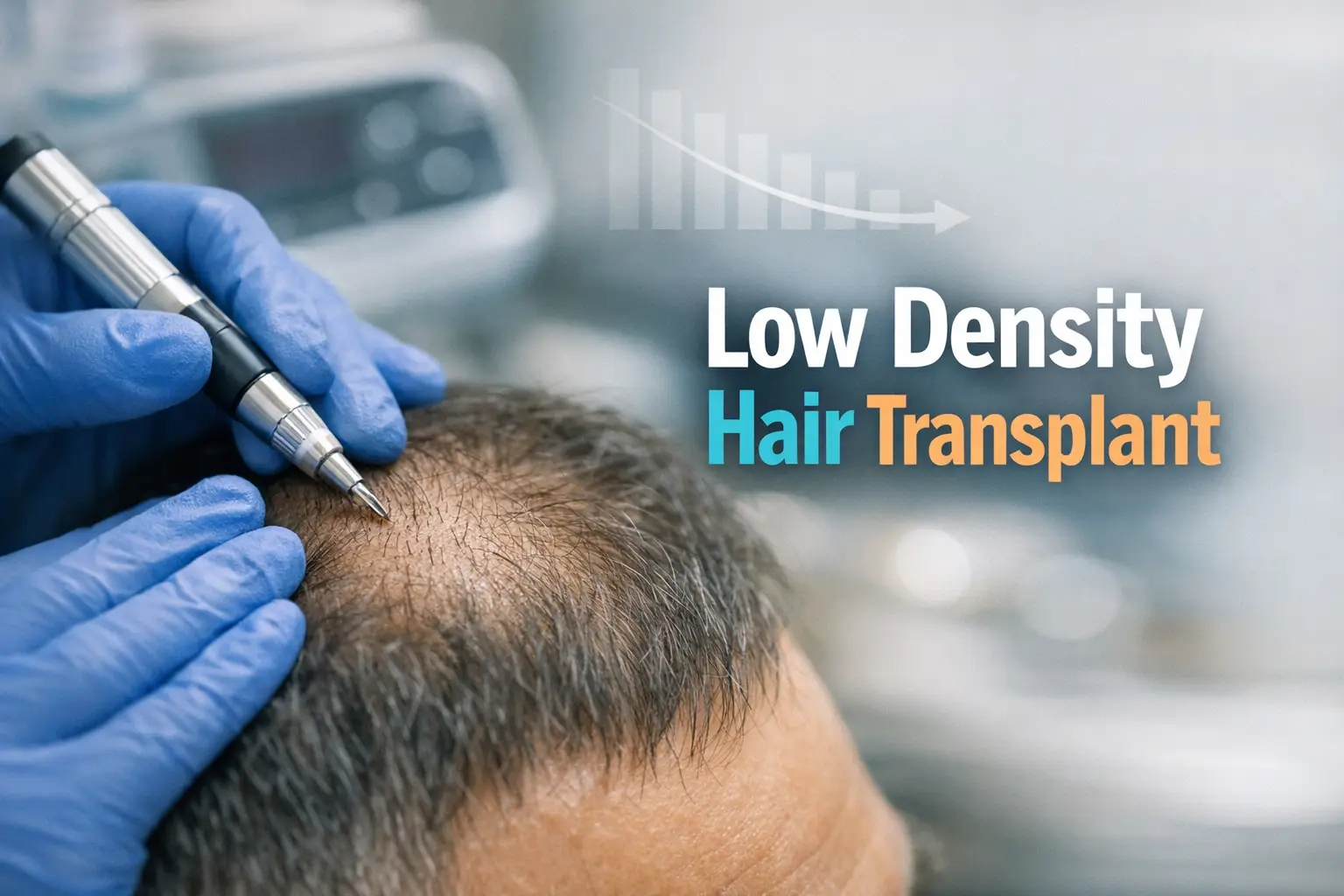
Many patients become concerned when a transplanted area appears thinner than expected. In some cases, low density may be part of normal planning; in others, it may be one of the visible outcomes of a hair transplant gone wrong, especially when graft survival, donor planning, or placement strategy has been compromised.
In reality, density is only one part of the equation. Hair thickness, texture, scalp contrast, donor capacity, and long-term hair loss progression all influence the final visual outcome. Understanding these factors helps set realistic expectations before treatment.
How Does Low Density Affect Transplant Results?
Hair density has a major impact on how full a transplant appears. When fewer follicular units are placed in a given area, more scalp may remain visible between hairs. This can create a lighter appearance, especially under bright lighting conditions or when the hair is wet.
However, low density should not automatically be viewed as a poor outcome. In many cases, it is a deliberate treatment strategy designed to achieve natural-looking coverage while preserving donor hair for future procedures.
When low density is unexpected, patchy, or combined with visible gaps, patients may also want to compare their result with the broader signs of a bad hair transplant.
Factors That Influence Visual Density
Two patients receiving the same number of grafts may experience very different visual outcomes. Several factors influence how dense the final result appears:
- Hair shaft thickness
- Hair texture and curl pattern
- Hair-to-scalp color contrast
- Recipient area size
- Graft survival rate
- Existing native hair density
For example, thick or curly hair generally provides more visual coverage than fine, straight hair. Likewise, patients whose hair color closely matches their scalp color often perceive greater density because scalp visibility is reduced.
Why Some Patients Choose a Low Density Approach
Low density transplantation is not always the result of limited graft availability. Some patients intentionally choose a conservative approach to maintain flexibility for future treatments. This is particularly relevant for younger individuals with progressive hair loss patterns.
By preserving donor reserves, patients may have more options available if additional restoration is required later in life. This is why careful donor management is essential; aggressive extraction may increase the risk of an overharvested donor area.
| Factor | Impact on Density Appearance |
|---|---|
| Thick Hair | Creates greater visual coverage |
| Curly Hair | Adds natural volume |
| Fine Hair | May require higher graft density |
| Low Hair-Scalp Contrast | Makes thinning less noticeable |
| Large Recipient Area | Can reduce perceived fullness |
Which Risks Come With Thin Graft Placement?
Thin graft placement can produce natural-looking results when performed correctly, but it also has limitations. If grafts are distributed across a very large area, the final appearance may lack the density some patients expect.
Potential Aesthetic Concerns
One of the most common concerns is visible scalp between grafts. Although the transplanted follicles may grow successfully, the overall coverage can appear lighter than anticipated.
- Visible scalp under strong lighting
- Reduced visual fullness
- Patchy appearance if planning is inadequate
- Need for future density sessions
- Less dramatic transformation after a single procedure
Low density can also affect the frontal appearance if the hairline is not planned carefully. For patients whose main concern is the front hairline looking sparse, harsh, or poorly blended, our guide on unnatural hairlines after hair transplant may be helpful.
Medical Considerations
Graft survival depends on proper harvesting, handling, implantation, and post-operative care. While low density placement generally causes less trauma than aggressive packing techniques, precision remains essential.
Potential complications include temporary shock loss, folliculitis, delayed healing, and visible scarring. These risks are not unique to low density transplantation but should be discussed before treatment.
Patients with autoimmune disorders, active scalp conditions, poor circulation, or unstable hair loss may require additional evaluation before surgery.
Who Is a Suitable Candidate for a Low Density Hair Transplant?
A low density approach may be suitable for patients who prioritize natural-looking enhancement over maximum density. It is also commonly considered when donor resources are limited or when long-term planning is important.
- Patients with mild to moderate hair loss
- Individuals with limited donor hair availability
- Younger patients with ongoing hair loss
- Patients seeking conservative improvement
- Individuals preserving grafts for future procedures
Who May Not Be a Suitable Candidate?
Not every patient is an ideal candidate for low density grafting. Some individuals may require a different strategy to achieve their goals.
- Patients expecting very dense coverage from a single session
- Individuals with extensive baldness requiring maximum graft numbers
- Patients with unrealistic expectations
- People unwilling to consider staged treatment plans
- Individuals with untreated scalp disorders
How Long Is Recovery After a Low Density Hair Transplant?
Recovery following a low density hair transplant is often relatively comfortable. Because fewer grafts are implanted, some patients experience less swelling, redness, and crust formation compared to larger procedures.
Typical Recovery Timeline
- Days 1–14: Initial healing period with mild redness and scabbing
- Weeks 2–4: Temporary shedding phase
- Months 3–4: Early hair growth begins
- Months 6–9: Noticeable cosmetic improvement
- Months 12–18: Final maturation of results
Patients should follow post-operative instructions carefully, avoid excessive sun exposure, and attend follow-up appointments to support healthy graft growth.
Additional treatments such as PRP may sometimes be recommended as part of a broader hair restoration plan, depending on individual needs.
Can Low Density Hair Transplant Results Be Improved?
Low density results may be improved if the donor area still has enough safe graft reserves and the scalp has healed properly. The correction strategy depends on whether the issue is caused by limited graft numbers, poor graft survival, wide recipient coverage, or progressive native hair loss.
Some patients benefit from additional grafting, while others may need supportive treatments or a staged plan to avoid placing too much pressure on the donor area. If low density is part of a previous unsatisfactory result, you can review our detailed guide on hair transplant repair options.
What Factors Influence the Overall Procedure Cost?
The cost of a low density hair transplant depends on several factors, including graft count, treatment technique, donor characteristics, and overall treatment complexity.
Hair transplant costs in Turkey are generally lower than in many European countries and the United States. These differences are typically related to healthcare infrastructure, operational expenses, and regional economic factors rather than a single aspect of treatment quality.
The final cost varies according to individual requirements, including:
- Number of grafts needed
- Extent of hair loss
- DHI or FUE technique selection
- Donor area characteristics
- Additional supportive therapies
- Long-term treatment planning
| Aspect | Low Density Hair Transplant | High Density Hair Transplant |
|---|---|---|
| Visual Coverage | More subtle and conservative | Greater immediate fullness |
| Donor Hair Usage | Preserves more donor reserves | Uses more grafts in a single session |
| Recovery | Often involves less trauma | May involve more swelling and crusting |
| Future Planning | May provide greater long-term flexibility | Can reduce future donor availability |
| Additional Sessions | May be required for increased fullness | Less commonly required initially |
Clinical Experience
In our clinical experience, patients often focus on graft numbers when discussing density. However, the placement strategy is frequently more important than the total number of grafts. Prioritizing the hairline and key framing areas can often create a stronger cosmetic improvement than distributing grafts evenly across a large thinning region.
Medical Review
This article has been reviewed for medical accuracy and reflects current principles used in modern hair transplantation. Treatment recommendations, graft requirements, and expected outcomes should always be determined through an individualized assessment performed by experienced hair transplant physicians.
Frequently Asked Questions
Does a low density hair transplant mean poor results?
No. Many low density transplants produce natural-looking outcomes when grafts are placed strategically and patient expectations are realistic.
Can density be increased later?
Yes. Additional sessions may be performed if donor availability and treatment goals allow for further enhancement.
Does hair type affect the final appearance?
Yes. Thick, curly hair generally creates the appearance of greater coverage compared to fine, straight hair.
How long does it take to see growth?
Most patients notice early growth after three to four months, with continued improvement over the following year.
Is low density hair transplant suitable for women?
It may be suitable for selected women with stable donor hair and localized thinning patterns. Individual assessment remains essential.
Additional FAQs
Does low density increase the risk of shock loss?
Shock loss can occur after any hair transplant procedure. Risk depends on multiple factors and is not determined by density alone.
Can low density grafting create a natural hairline?
Yes. Many surgeons intentionally use lower density placement at the front of the hairline to mimic natural hair growth patterns.
Scientific References
View Scientific References
Follicular Unit Transplantation: 2005
Bernstein RM, Rassman WR. Dermatologic Surgery. PMID: 15937881.
Hair Restoration: Surgical and Medical Options
Shapiro R, et al. Journal of the American Academy of Dermatology. DOI: 10.1016/j.jaad.2010.10.043.
Follicular Unit Extraction: Minimally Invasive Surgery for Hair Transplantation
Rassman WR, et al. Dermatologic Surgery. DOI: 10.1046/j.1524-4725.2002.01144.x.
Hair Transplantation: A Review of Current Techniques and Future Directions
Jimenez F, Ruifernandez JM. Clinics in Dermatology. DOI: 10.1016/j.clindermatol.2018.08.004.